Last updated October 15, 2026
ADU Cost Breakdown: The Sacramento Homeowner’s Reference for 2026
The $350-per-square-foot number you’ll find in every Sacramento ADU article is real, and it’s also almost useless for planning your actual budget. A 700-square-foot one-bedroom ADU at $350/sq ft pencils out to $245,000, but in 2026 the true cost in Sacramento runs closer to $280,000 to $340,000 once you account for the line items that never make it into a per-square-foot average: sewer capacity fees, a subpanel upgrade, tree removal, and five months of construction loan interest. This guide-along with our The Complete Guide to ADU in Sacramento-breaks down the four cost buckets that decide whether a Sacramento ADU comes in on budget or blows past it: soft costs, hard costs, site costs, and carrying costs.
Quick Answer
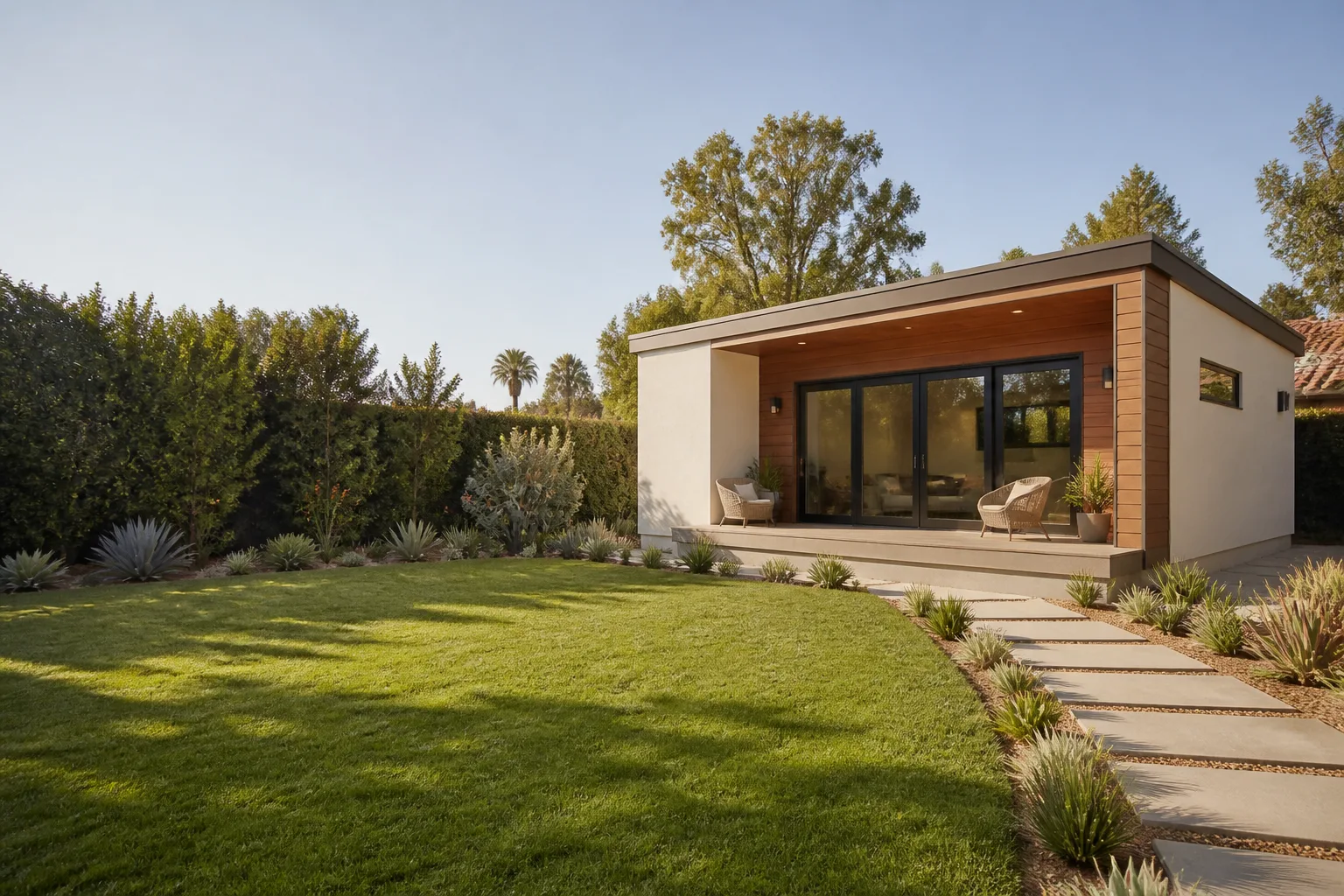
A new detached ADU in Sacramento will cost between $250,000 and $420,000 in 2026, depending on size, site conditions, and whether you choose prefab or stick-built. The per-square-foot cost that matters is $280 to $520 for site-built and $300 to $450 for premium prefab, but roughly 35 percent of your total budget will go to costs that have nothing to do with square footage: permits, fees, utility connections, site prep, and loan interest. The most reliable way to get an accurate number is to start with a written, line-item price from a contractor who puts everything in writing before work begins.
Table of Contents
- The Four-Bucket Framework: How ADU Costs Actually Break Down in Sacramento
- Soft Costs: Permits, Design, and Engineering in Sacramento
- Hard Costs: Materials and Labor, Site-Built vs. Prefab
- Site Costs: The Sacramento Bucket That Surprises Everyone
- Carrying Costs: Interest, Displaced Rent, and the Hidden Meter
- Sacramento Utility Fees and Connection Charges, Itemized
- Prefab vs. Stick-Built in Sacramento: An Honest Cost Comparison
- How to Read a Sacramento ADU Contractor Quote
- Common Mistakes to Avoid
- When to Call a Professional
- Frequently Asked Questions
The Four-Bucket Framework: How ADU Costs Actually Break Down in Sacramento
Most ADU cost guides treat the project like a uniform box: size multiplied by a single rate, plus maybe a vague allowance for “permits.” In reality, a Sacramento ADU has four completely separate cost structures, and homeowners who understand them can spot a bad bid in five minutes. Here’s what we’ve seen across hundreds of projects in Sacramento:
Soft costs are the non-construction expenses that happen before and alongside the physical build: architectural drawings, structural engineering, Title 24 energy calculations, city permit fees, school impact fees, and utility connection charges. In Sacramento, these typically run $22,000 to $45,000, and on a smaller ADU they can represent 12 to 18 percent of the total budget; for a deeper look at what drives these fees, see ADU Permits, Codes & Inspections in CA: What You Need to Know.
Hard costs are the materials and labor that make the ADU physically exist: foundation, framing, drywall, roofing, windows, flooring, cabinetry, plumbing, electrical, and HVAC. This is the bucket where the per-square-foot math actually applies, and in Sacramento it runs $220 to $350 per square foot for a site-built ADU, or $250 to $380 per square foot for a quality prefab ADU before site work is added.
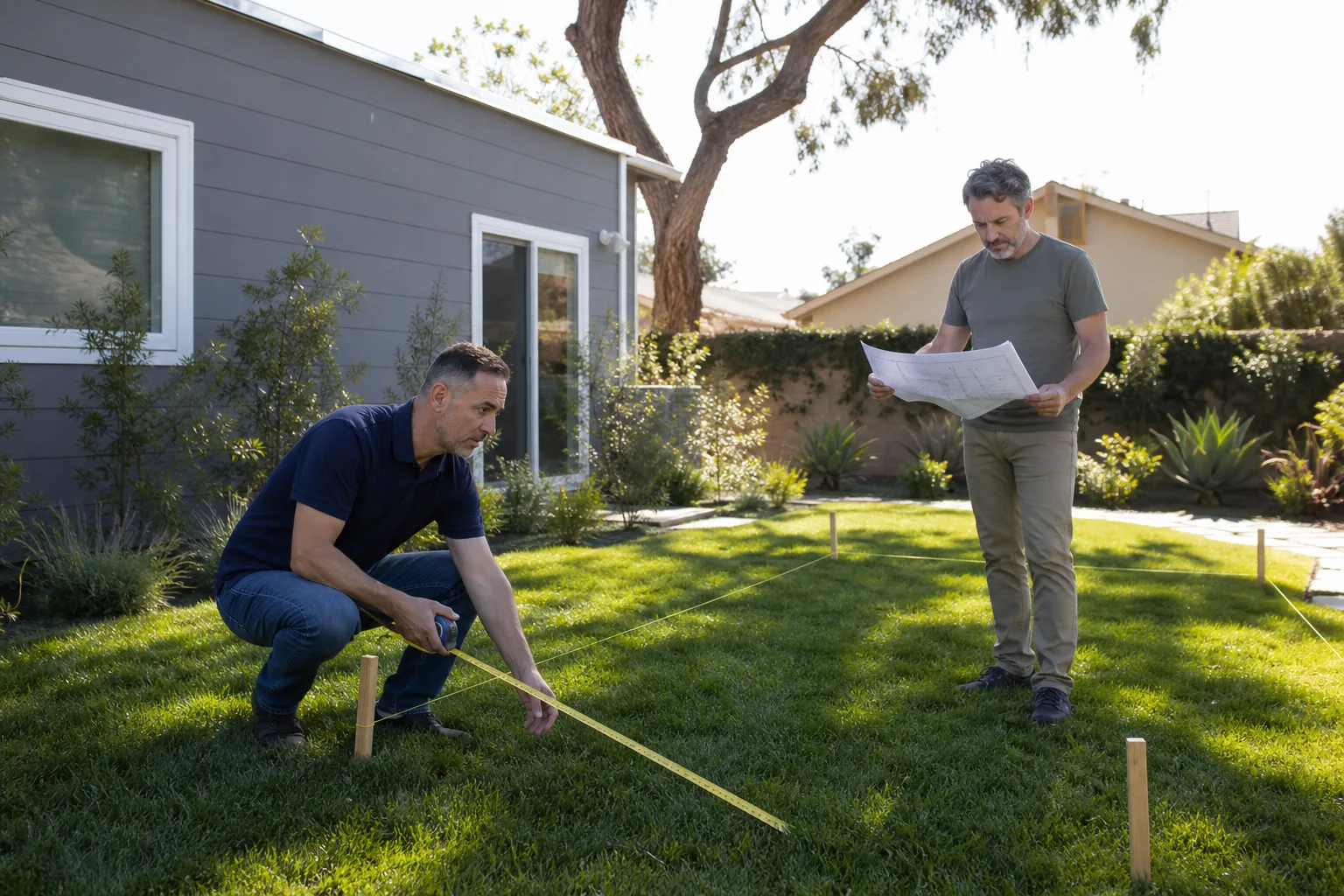
Site costs are the wildcard. These are the expenses tied to your specific lot: grading, retaining walls, tree removal or root mitigation, trenching utilities from the main house, disconnecting and updating an old electrical panel, and demolition of any existing structures. On a flat Sacramento infill lot, site costs can be as low as $12,000. On a sloped lot in East Sacramento or Land Park with mature trees and 60 feet of trenching from the street, they can exceed $70,000.
Carrying costs are the silent budget-killers. If you finance the ADU with a construction loan, you’re paying interest on the full balance while the project is underway. If you build an ADU where you currently park or garden, you may pay for off-site storage or disrupt rental income on the main house. In Sacramento, carrying costs on an eight-month build typically add $8,000 to $20,000 to the total, and almost no online cost guide includes them.
Soft Costs: Permits, Design, and Engineering in Sacramento
Soft costs are the first money you’ll spend and the easiest to underestimate, because none of them involve swinging a hammer. In Sacramento, here’s what the line items actually look like:
- Architectural and design fees: $6,000 to $18,000 for a custom detached ADU. Prefab ADUs often include design in the base price, which is one reason the prefab route appeals to Sacramento homeowners who want fewer upfront unknowns.
- Structural and civil engineering: $3,500 to $9,000, depending on whether your lot requires soils testing, foundation design for expansive clay (common in parts of Sacramento County), or custom roof load calculations.
- Title 24 energy compliance: $800 to $2,500. California’s energy code requires a compliance model for every new ADU, and Sacramento’s hot summers mean your cooling load calculations drive the design.
- City of Sacramento permit fees: $6,000 to $15,000 depending on the project valuation and square footage. The City calculates these on a sliding scale; larger ADUs pay proportionally more.
- School impact fees: $4 to $5 per square foot for Sacramento’s school districts, so a 750-square-foot ADU adds roughly $3,000 to $3,750. ADUs under 750 square feet are exempt from some impact fees, but only if the primary residence is owner-occupied.
One pattern we’ve seen repeatedly in Sacramento: homeowners who budget exactly $15,000 for soft costs and then discover the sewer connection fee, the SMUD meter charge, and the school district fee were all excluded from the original quote. A reputable builder’s estimate will itemize every single city and utility fee on day one, not bury them in a “TBD” column-one of the ADU Warning Signs: A Sacramento Homeowner’s Reference Guide we publish to help homeowners spot red flags early. That’s the entire point of requiring a written price before work starts: if the fee isn’t on the page, you haven’t been quoted for it yet.
Hard Costs: Materials and Labor, Site-Built vs. Prefab
Hard costs are where the per-square-foot comparison actually works, and in Sacramento the range is wider than most national guides suggest. For a site-built ADU in 2026, expect $220 to $300 per square foot for a straightforward one-bedroom build with mid-grade finishes, and $300 to $350 per square foot for a two-bedroom with upgraded kitchens, higher ceilings, or accessibility features. Labor accounts for roughly 45 to 55 percent of these costs, and Sacramento’s construction labor market has tightened in recent years, which means the days of the $200-per-square-foot site-built ADU are behind us.
Here’s a representative hard-cost breakdown for an 800-square-foot, one-bedroom site-built ADU in Sacramento:
- Foundation: $18,000 to $28,000 (concrete slab or raised floor, including seismic hold-downs required by California code).
- Framing and structural lumber: $35,000 to $48,000 for walls, roof, and sheer paneling. Lumber prices stabilized after the 2021-2022 spike but still run 20 to 30 percent above pre-pandemic levels.
- Roofing: $8,000 to $14,000 for composition shingles, more for metal or tile. Sacramento’s sun exposure shortens shingle life, so a reflective or ENERGY STAR roof can offset cooling costs over the ADU’s life.
- Windows and doors: $7,000 to $13,000. Dual-pane, low-E windows are code minimum in California and non-negotiable in Sacramento’s climate.
- Kitchen and bath finishes: $18,000 to $35,000 depending on cabinet grade, countertop material, and fixture choices. This is the line item where allowance games happen; more on that below.
- Electrical, plumbing, HVAC: $30,000 to $50,000 combined. A mini-split heat pump is the standard heating and cooling solution for Sacramento ADUs and typically runs $6,000 to $10,000 installed.
Prefab hard costs look different because labor happens in a factory. A premium prefab ADU from a brand like Abodu or Cover typically runs $250 to $380 per square foot for the unit itself, delivered and craned onto your prepared foundation. The factory build includes design, engineering, and a fixed material list, but you’ll still pay separately for the foundation, utility hookups, and finish site work. Tuff Shed offers a budget-oriented shell option that can be converted to living space, though in Sacramento those conversions still require full permitting and mechanical upgrades, so the savings are often smaller than the base price suggests.
ADU Builders in Sacramento who offer multiple prefab brands give you a real comparison point: a site-built 800-square-foot ADU and a comparable Abodu unit might land within $20,000 of each other once site work is included, and the deciding factor is usually timeline, not total cost.
Site Costs: The Sacramento Bucket That Surprises Everyone
Site costs are where Sacramento ADU budgets get broken, and the reason is simple: every online cost guide assumes a flat, clear lot with utilities in the right place. Almost no urban lot in Sacramento actually looks like that. Here’s what we see in the field:
Utility trenching. If your detached ADU sits at the back of the lot, the electrical feeder line, water supply, and sewer lateral all need to be trenched from the main house. Trenching costs $45 to $85 per linear foot. A 40-foot run with a clean path: $2,000 to $3,500. A 60-foot run through tree roots, under a concrete driveway, or around a pool: $8,000 to $15,000.
Electrical panel capacity. A 1960s-era Sacramento home with a 100-amp panel cannot support an ADU with a mini-split, electric water heater, induction range, and laundry. Upgrading to a 200-amp panel, including the service drop and city inspection, runs $4,500 to $9,000. If the service line from the utility pole is underground and undersized, add another $3,000 to $6,000. This is the single most common surprise line item in Sacramento ADU projects.
Trees and roots. Sacramento is the City of Trees, which means mature canopy everywhere and root systems that mess with slabs, sewer lines, and trench paths. Tree pruning or removal runs $800 to $4,000 depending on size and access. Root barriers or foundation adjustments for a large oak within 20 feet of the ADU add $2,000 to $8,000. If the tree is protected – Sacramento has ordinances protecting certain native species – you’ll need an arborist report and potentially a modified foundation design.
Grading and drainage. Flat Sacramento lots drain poorly in the winter. A proper pad, drainage swale, and possible retaining wall for a sloped lot add $4,000 to $20,000. The city requires that new impervious surfaces not redirect stormwater onto neighboring properties, so drainage planning is not optional.
No builder can see all of these conditions before a site visit. What a good builder can do is flag the likely ones during the estimate, inspect for unknowns before you sign, and hold the written price firm on the items you both agreed were known. If a quote has “$5,000 allowance for site work” and nothing else, that’s not a quote; it’s a placeholder.
Carrying Costs: Interest, Displaced Rent, and the Hidden Meter
Every month an ADU is under construction is a month you’re paying for financing, not rent. Construction loans in 2026 carry rates roughly one to two points above a standard mortgage, and interest accrues on the full loan balance from the first draw. On a $300,000 ADU financed at 7.5 percent over an eight-month build, the interest alone is $9,000 to $12,000 before the ADU ever generates a dollar.
Prefab construction shortens this timeline, and that’s one of the least-discussed cost advantages of the prefab route. A factory-built ADU from Cover or Abodu can go from permitted to placed in 12 to 16 weeks in Sacramento, compared with 6 to 9 months for a typical site-built project. The carrying cost savings alone can be $5,000 to $8,000, which partially offsets the premium you pay for the prefab unit itself.
Then there’s displaced rent. If you’re building an ADU where the previous tenants of your garage conversion or the space itself were generating income, or if the project disables a parking space you rent, or if the construction makes part of your yard unusable for six months, those losses are real. A smaller, often-overlooked carrying cost: if construction reroutes a driveway or closes a home office, you may lose $1,000 to $3,000 in productivity or convenience value without ever seeing a line item.
For Sacramento homeowners financing the entire project, the true carrying cost formula looks like this:
- Take your total loan amount.
- Multiply by the interest rate, divided by 12, times the number of months of construction.
- Add any lost rental income or storage fees during the build.
- Add the cost of refinancing or converting the construction loan to permanent financing at the end.
On a seven-month site-built project with a $320,000 loan, we regularly see $15,000 to $18,000 in total carrying costs by the time the certificate of occupancy is issued.
Sacramento Utility Fees and Connection Charges, Itemized
Sacramento’s utility fee structure is more transparent than many California cities, but that transparency doesn’t make the fees smaller. Here’s exactly which agencies collect what, and when the payment hits:
SMUD (Sacramento Municipal Utility District): SMUD charges $800 to $2,500 for a new service connection or meter, depending on whether the ADU gets its own meter or a subpanel off the main house. A separate meter is the right call if the ADU will be a rental; it makes utility billing clean and prevents disputes. The fee is due when the service is connected, typically midway through construction.
Sacramento Regional San (sewer): The sewer capacity charge is the single most overlooked fee in Sacramento ADU projects. Sacramento Regional San charges a connection fee for new sewer service that runs $3,000 to $9,000 depending on the ADU’s fixture count and whether a new lateral is physically installed from the property to the main line. If the trench runs under a street or sidewalk, the road-cut and restoration cost is separate and can add $2,000 to $5,000. This fee is due before final inspection, though the estimate should be requested early, since the actual cost depends on the lateral path.
City of Sacramento Public Works: The city charges for the encroachment permit if you’re cutting a curb or sidewalk for the sewer lateral, plus the standard building permit already covered under soft costs. Encroachment permits run $1,200 to $3,000. If the city requires a sewer lateral replacement because the existing line is old clay pipe (common in Midtown, Land Park, and East Sacramento), that’s a separate $6,000 to $12,000 bill the homeowner is often surprised to see.
These three agencies each operate on their own timeline, and none of them coordinate with the others. A smart Sacramento ADU project starts with a utility strategy meeting: confirm panel capacity, confirm sewer lateral condition, confirm water meter size. These three items, checked in week one, prevent $15,000 surprises in month five.
Prefab vs. Stick-Built in Sacramento: An Honest Cost Comparison
The most honest thing we can tell you about prefab versus stick-built is this: prefab is not cheaper on total project cost, but it is cheaper on carrying cost, and it removes most of the construction-site chaos. Here’s how the numbers shake out in Sacramento for an 800-square-foot one-bedroom ADU:
Site-built total: $280,000 to $360,000, broken down as $220 to $300 per square foot in hard costs, plus a typical $35,000 to $50,000 in site and soft costs not included in the square-foot math.
Premium prefab (Abodu or Cover) total: $290,000 to $380,000, with the unit itself priced at $250 to $380 per square foot, delivered and installed, plus $25,000 to $45,000 in site work for foundation, utilities, and finishes. The factory build includes architecture and engineering in the unit price, which removes $10,000 to $20,000 from the soft cost bucket.
Budget prefab shell (Tuff Shed conversion): $140,000 to $200,000 all-in for a converted structure, but only if you keep the finishes minimal and the square footage under 500. Sacramento ADU code still requires full permitting, insulation, mechanical, and egress, so the shell itself is often the smallest line item by the time you’re done.
Where prefab genuinely wins in Sacramento: timeline. A factory-built unit arrives in a matter of months, not seasons. For a homeowner financing the ADU and wanting rental income quickly, the carrying-cost savings can erase the price premium entirely. Where prefab doesn’t win: custom site layouts. If your Sacramento lot is narrow, sloped, or obstructed, a factory panel home may not fit without crane access and assembly room, while a stick-built crew can adapt to almost anything.
Because Benson ADU Sacramento is authorized to build with multiple prefab brands, including Abodu and Cover, we can run the comparison on your actual lot rather than a national spec sheet. The right answer for a flat Natomas lot is often different from the right answer for a narrow Land Park lot with 100-year-old oaks.
How to Read a Sacramento ADU Contractor Quote
Most homeowners read a bid like it’s a restaurant menu: find the total, check it against the other guy’s total, choose. That’s how you end up owing $47,000 more than the contract said. Here’s how to actually read a Sacramento ADU quote:
- Find the three allowance line items. Allowances are placeholders, not prices. If a quote says “$6,000 appliance allowance” and you want a mid-range kitchen, you’ll owe more. The three allowances every homeowner should force into actual dollars are: site work, electrical service, and finish materials. If those aren’t fixed, the quote isn’t fixed.
- Look for the words “as needed” or “per actual cost.” These phrases are open-ended checks. “Trenching as needed” means you’re paying whatever the crew decides. “Drainage per actual cost” means you’re holding the risk. Nothing wrong with a contingency line, but it should be capped, not open.
- Require a schedule of values. This is the financial breakdown by phase: foundation, framing, mechanical, finishes. Without it, you can’t verify progress against payments. A written price without a schedule of values is not a written price.
The three most commonly underestimated line items in Sacramento ADU quotes are:
Site work: We covered the range above. If a quote gives site work a single round number like “$8,000” without a site visit, expect to pay double when the trench runs through roots and under a patio.
Electrical panel upgrades: Builders who quote before checking the panel are guessing. A panel upgrade to 200 amps is the most common mid-project change order in Sacramento, and it’s completely avoidable with a two-minute inspection in week one.
Finish allowances: “$25 per square foot for flooring” sounds real because it has a dollar sign. Then you see the available options and discover the floor you’d actually put in a rental unit costs $38 per square foot installed. Allowances are often set at builder-grade levels intentionally to make the headline number look competitive.
A written Price Before Work Starts, in our view, means every one of these three line items is locked. If it’s an allowance, it’s labeled as such, capped in writing, and reconciled with receipts. A Home Addition Contractor in Sacramento who can’t show you a line-item schedule is asking you to underwrite their risk.
Common Mistakes to Avoid
- Using the national $350/sq ft number as a budget line. Sacramento’s fee structure, soil conditions, and labor market are specific to this city. A national average absents the sewer lateral cost, the SMUD connection, and the panel upgrade, which are three of the four most common big-ticket surprises.
- Accepting a verbal estimate as a price. A verbal estimate is not a bid. In Sacramento, the variance between a verbal estimate and a final invoice on a complex ADU project commonly runs $25,000 to $40,000. A written price before work starts is the only thing that closes that gap.
- Budgeting for the ADU but not the carrying costs. Construction loan interest, refinancing fees, displaced rent, and six months of yard disruption are all part of the project cost. Financing a $300,000 build at 7.5 percent for eight months adds $9,000 to $12,000 just in interest.
- Skipping the sewer lateral inspection. Many Sacramento homes still have original clay sewer lines. A $300 camera inspection before you design the ADU can reveal a $10,000 lateral replacement you’d otherwise discover when the trench opens.
- Treating all prefab brands as interchangeable. Tuff Shed, Abodu, and Cover solve different problems at different price points. A converted shed is not a factory ADU, and a factory ADU is not a custom site-built home. Get the comparison on your actual lot.
- Underestimating Sacramento’s cooling loads. A poorly insulated ADU or an underpowered mini-split will produce July energy bills that make a tenant complain and a homeowner regret. Title 24 compliance is the floor, not the ceiling.
- Building without knowing the rental math first. If the ADU is an income property, build it with the tenant in mind: separate meter, quiet HVAC, rental-grade finishes, and a layout that leases easily in Sacramento’s rental market. The time to think like a landlord is at the design stage, not after the first turnover.
When to Call a Professional
You don’t need a builder to read a quote, but you should have a builder on the phone before you spend a dollar on design. If your lot has any of the following conditions, schedule a site visit early: mature trees within 20 feet of the build area, a 100-amp electrical panel, a sloped lot with drainage concerns, a sewer lateral more than 40 years old, or an unknown structure from a previous era of the property. A professional who walks the site once can save you $20,000 in surprises by simply looking at the panel, the trees, and the trenching path before you commit to drawings. If you’re still in the information-gathering stage, Benson ADU Sacramento home page and guide library covers Sacramento ADU topics in depth, and our team offers free estimates in Sacramento at (279) 254-1808. Bring us the lot, and we’ll bring you a written price with every fee, allowance, and carrying cost accounted for.
Frequently Asked Questions
A detached ADU in Sacramento costs between $250,000 and $420,000 all-in for 2026, with most one-bedroom units landing between $280,000 and $360,000. The per-square-foot cost is $280 to $520 for site-built and $300 to $450 for premium prefab, but roughly 35 percent of your budget goes to soft costs, site costs, and carrying costs that don’t scale with square footage. For more guides & resources, explore our blog, or call (279) 254-1808 for a written line-item estimate on your specific lot.
The cheapest permitted ADU path in Sacramento is a garage conversion or a small site-built unit under 500 square feet, with a total cost around $140,000 to $200,000. A Tuff Shed conversion can reduce hard costs, but you’ll still pay $20,000 to $35,000 in soft and site costs before the unit is habitable, so the savings are smaller than the shell price suggests. For the best true-cost comparison of prefab and site-built options, call (279) 254-1808 with ideas in mind and we’ll price them side by side.
A site-built ADU in Sacramento typically takes 6 to 9 months from permit approval to certificate of occupancy, while a prefab ADU from Abodu or Cover can be placed in 12 to 16 weeks after permits clear. The timeline includes city inspection windows, utility connection scheduling, and Sacramento’s rainy season, which can pause exterior work between December and February. For the timeline that matches your lot and chosen build method, call (279) 254-1808.
Yes, every ADU in Sacramento requires a building permit from the City of Sacramento, and the permit process typically adds 2 to 4 months to your timeline and $6,000 to $15,000 in fees. Unpermitted ADUs are not legal rentals, not insurable, and not sellable for the value you’ve built, so the permit path is the only one that generates real equity. Our team handles the full permit package as part of the written price.
Yes, Sacramento homeowners finance ADUs through construction loans, cash-out refinancing, home equity lines of credit, or California’s CalHFA ADU grant program, which offers up to $40,000 for qualifying homeowners. The financing route you choose directly affects your carrying costs, so compare interest rates and draw schedules before signing. We’ll walk through the numbers with you as part of the free estimate process.
If you signed a fixed-price contract with a written schedule of values, the price should not change for any item that was inspectable before work began, which is why Benson ADU Sacramento requires a site visit, panel check, and sewer lateral camera before we issue a written price. The only legitimate changes in a fixed-price ADU contract are true unknowns uncovered after demolition, and even those should be capped in writing. If a builder won’t put the price in writing before work starts, that’s the signal you need to make a different call.
The Bottom Line
A Sacramento ADU is a six-figure investment, and the difference between a project that holds its budget and one that doesn’t comes down to the four buckets: soft costs you can plan for, hard costs you can compare, site costs you must inspect, and carrying costs you cannot ignore. The $350-per-square-foot number gets you in the ballpark; the written, line-item price gets you to the closing table. Sacramento’s fee structure is knowable, its lots are inspectable, and its builders are measurable. Get the site visit, insist on the written price, and build with someone who puts the entire number on the page before the first shovel turns.
Written by Troy Eastman, Owner at Benson ADU Sacramento, serving Sacramento since 2006.